- Home
- News
- Restoring a Classic Motorcycle
RESTORING A CLASSIC: BRINGING VINTAGE MOTORCYCLES BACK TO LIFE
A vintage motorcycle restoration is one of the most rewarding projects a workshop can take on — and one of the most demanding. From sourcing period-correct parts to matching factory paint codes that no longer exist, every step requires patience, skill, and a genuine love for the machines.
Classic and vintage motorcycles present challenges that modern bikes simply don't. Parts availability drops dramatically as models age. Factory paint codes from the 1960s, 70s and 80s require custom mixing — sometimes from scratch. Plastics that were standard on early fairings may no longer be manufactured in the same formulation. Getting a restoration right means solving these problems methodically, one by one.
WHERE EVERY RESTORATION STARTS
A proper restoration begins with a full strip-down and assessment. Every panel, fastener, and bracket is removed and catalogued. We photograph each component before anything is touched, creating a documented baseline that guides reassembly and helps identify what can be saved versus what needs to be sourced or fabricated.
The assessment phase often uncovers hidden damage — stress cracks beneath old paint, rust behind chrome trim, or poorly done previous repairs that need to be reversed before proper restoration work can begin. This is the unglamorous part of a restoration, but it's where the quality of the final result is determined.
THE KEY STAGES OF A CLASSIC MOTORCYCLE RESTORATION
-

Full strip and catalogue — Every component is removed, cleaned, assessed and documented before any work begins
-
Structural repair — Cracks, fractures and corrosion are addressed first; cosmetic work cannot cover structural problems
-
Period-correct paint mixing — Factory codes from 30–60 years ago are matched using archive data and spectrophotometry where original references are unavailable
-
Documented reassembly — Every component goes back in documented sequence, with photographs at each stage for provenance
"
A restoration done right is invisible — you shouldn't be able to tell what was repaired and what was original. That means the same standard of surface prep, the same paint system, and the same attention to finishing detail that the factory applied when the bike was new.
— Rod Seddon, Owner & Director, Melbourne Motorcycle Fairings
SOURCING PARTS FOR CLASSIC BIKES
Parts availability is the single biggest challenge in any vintage restoration. For bikes from the 1960s and 70s, OEM parts are rarely available new. The options are: source quality used parts, have components fabricated, or adapt similar parts from related models. We've built up a network of suppliers over 20 years that gives us access to parts that most workshops simply can't find.
- NOS (New Old Stock) parts are the gold standard but increasingly rare — we source from specialist dealers and international networks
- Quality used parts can be reconditioned — stripped, blasted, repainted or re-chromed to original specification
- Some brackets, guards and trim pieces can be accurately fabricated in steel or aluminium when no originals exist
- Fibre glass fairings from discontinued models can sometimes be reproduced using mould-making from surviving examples
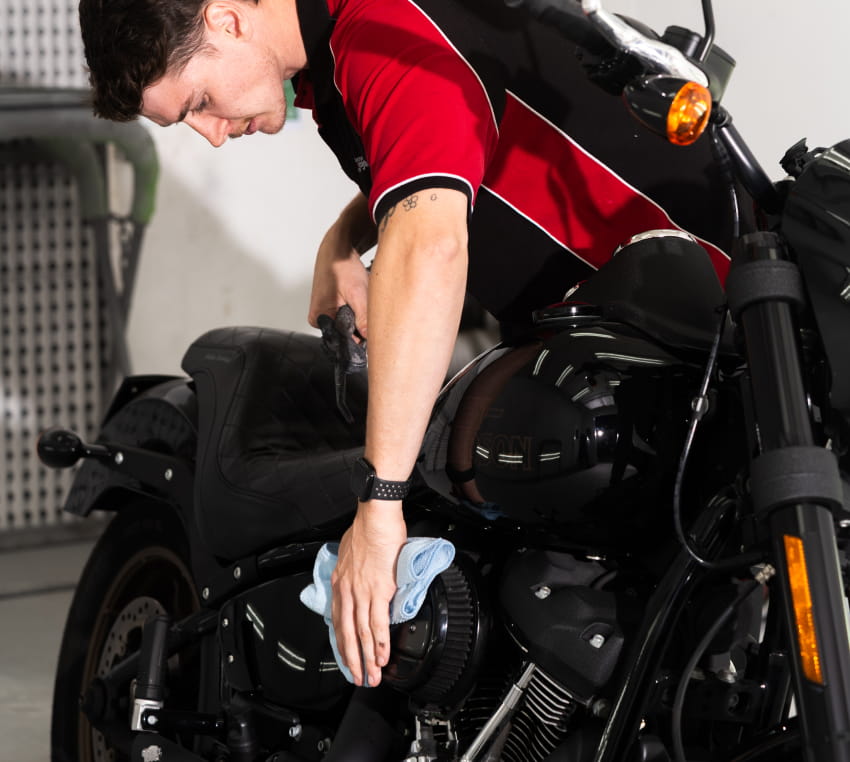
Period-correct colour matching is one of the most technically demanding parts of any vintage restoration
MATCHING VINTAGE PAINT CODES
Factory paint codes from older bikes often can't be directly cross-referenced into modern paint systems. Pigments and formulations have changed, some colours have been discontinued entirely, and the original paint on a 40-year-old bike has aged significantly from its original appearance. Our process for vintage colour matching involves researching archive data, cross-referencing with surviving examples in known condition, and mixing by hand with spectrophotometer verification.
Show Standard vs Ride Standard
Before starting any restoration we discuss with the owner what the end use will be. A show-standard restoration aims for absolute period accuracy — every detail matched to factory spec, every surface flawless. A ride-standard restoration focuses on quality, durability and authenticity while accepting minor practical concessions. Both are valid — but they require different approaches to materials and finishing, and different budgets.
- Show standard work uses period-correct paint types where possible, including single-stage lacquers for appropriate era bikes
- Ride standard work typically uses modern 2K clear for durability, with period-correct colour and finish appearance
- All restoration work is fully documented and photographed for owner records and future provenance
Written by
Rod Seddon
Owner & Director — Melbourne Motorcycle Fairings
Rod has restored dozens of classic and vintage motorcycles over his 20+ year career, from early Japanese two-strokes to British twins. He approaches every restoration as a research project as much as a craft exercise.
 Mon - Fri: 8:00 am - 4:30 pm
 Factory: 14 / 59, Hudsons Road, Spotswood
 info@melbournemotorcyclefairings.com.au