- Home
- News
- Understanding Motorcycle Paint Systems
UNDERSTANDING MOTORCYCLE PAINT SYSTEMS: CANDY, PEARL & METALLIC
A guide to different motorcycle paint finishes and why professional colour matching
matters
for crash repairs — and why most repairers simply can't do it right
If your motorcycle has been in a crash, one of the most technically demanding parts of
the
repair isn't the mechanical work — it's getting the paint exactly right. Motorcycle
paint
systems are far more complex than most people realise, and the difference between a
professional result and a visible patch job almost always comes down to understanding
the
finish you're dealing with.
WHY MOTORCYCLE PAINT IS DIFFERENT
Unlike most automotive paint, motorcycle fairings often use specialist paint systems
that
require specific knowledge, equipment and technique to reproduce accurately. Standard
panel
beaters who work on cars may not have the experience or the materials to match these
finishes correctly — and the result is a repair that looks fine from a distance but
obvious
up close.
At Melbourne Motorcycle Fairings, we've spent over 20+ years mastering the three main
types
of motorcycle paint finish: candy, pearl and metallic. Each has its own application
process,
and each requires a different approach to colour matching.
KEY PAINT SYSTEMS AT A GLANCE
-

Candy Paint — A translucent colour coat applied over a
metallic base. The
depth and hue change with viewing angle. Extremely difficult to match
without
specialist knowledge of the original base coat
-
Pearl Finishes — Multi-layer systems that use mica
particles to create a
shifting, luminous quality. The pearl layer must be applied at the correct
thickness and angle for the effect to match
-
Metallic Paint — Contains aluminium flakes suspended in the
paint. Flake
size,
density and the angle of application all affect the final appearance. Very
easy
to mismatch without spectrophotometer colour reading
CANDY PAINT: THE MOST DEMANDING FINISH
Candy paint is arguably the hardest motorcycle finish to repair correctly. The
system
works
by applying a transparent or semi-transparent colour coat — the "candy" layer — over
a
reflective metallic base, usually silver or gold. The base coat creates the
brightness;
the
candy layer provides the colour and depth.
Why Candy Paint Is So Hard to Match
The problem with repairing candy paint is that the number of candy coats applied at the
factory determines the depth and intensity of the colour. Apply too few and the repair
will
look lighter. Apply too many and it darkens. Getting this right requires knowing the
original specification and having access to the correct candy concentrate — something
many
repairers simply don't stock.
- The base coat metallic must match in both colour and flake size
- The number of candy coats must replicate the factory application
- Blending into adjacent panels is often impossible without repainting entire sections
- Fading and UV exposure on the original paint must be factored into the mix
"
Getting a candy paint repair right isn't just about matching a colour code. It's
about
understanding the entire system — the base, the candy concentration, the number of
coats, and how the original paint has aged. Skip any of those variables and the
repair
will show.
— Rod Seddon, Owner & Director, Melbourne Motorcycle Fairings
PEARL FINISHES: LAYERS OF COMPLEXITY
Pearl paint systems use fine mica particles — a naturally occurring mineral — to
scatter
light and create that distinctive shifting, luminescent quality. Depending on the
angle
of
light, a pearl finish can appear almost white, or rich with colour. Factory pearl
systems
often use two or three pearl layers, each with different particle sizes.
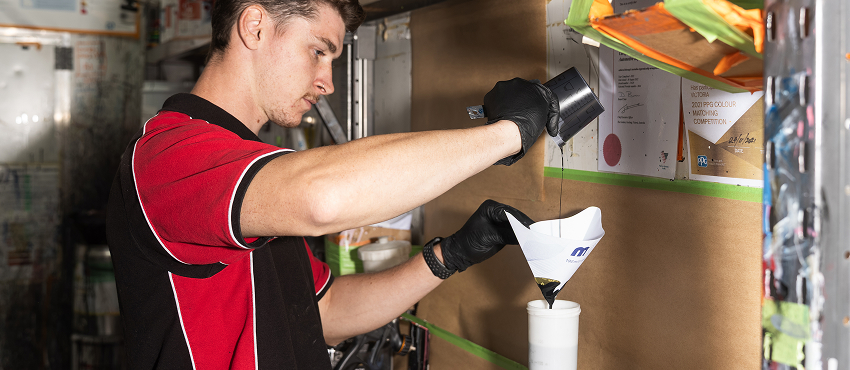
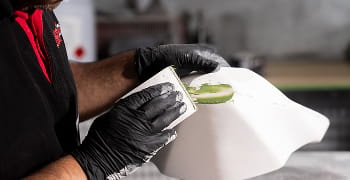
Precision colour mixing for a perfect finish
Matching Pearl Finishes Accurately
To accurately match a pearl finish, we use a spectrophotometer to read the existing
paint at
multiple angles. This gives us data on how the colour and pearl effect shift with
the
viewing angle — something a visual colour match alone can never achieve with
consistency.
Once we have that data, we can select the correct pearl concentrate, size and ratio.
METALLIC PAINT: FLAKES, ANGLES & EQUIPMENT
Metallic paint contains small aluminium flakes suspended in the paint. These flakes
orient
themselves as the paint dries, catching and reflecting light. The visual result
depends
on
flake size, flake density, and application technique — particularly the spray
distance
and
air pressure used during application.
The Equipment Factor
Replicating a factory metallic finish correctly requires calibrated spray equipment
and
the
correct reducer ratios for your spray environment — temperature and humidity both
affect
how
flakes lie. Most general repairers working on cars don't have the specific materials
for
motorcycle finishes, nor the experience to adjust their technique for smaller
motorcycle
panels.
- Spray distance affects flake orientation and brightness
- Reducer type and ratio affect open time and flake lay
- Panel size requires adjusted technique versus larger automotive panels
- Temperature and humidity in the spray booth must be controlled
WHY IT MATTERS FOR CRASH REPAIRS
If your motorcycle has been damaged in a crash, your insurer will want the repair
completed
as quickly and cost-effectively as possible. The risk is that you end up with a repair
that's structurally sound but visually obvious — panels that don't quite match the rest
of
the bike, or a colour that looks right in the photos but wrong in the sunlight.
Choosing a repairer who understands these paint systems — and has the materials and
equipment to execute them properly — is the difference between a repair you'll never
notice
and one you'll see every time you look at your bike.
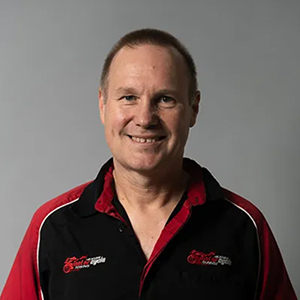
Written by
Rod Seddon
Owner & Director — Melbourne Motorcycle Fairings
Rod has been repairing and repainting motorcycles for over 20+ years. As co-owner
of
Melbourne Motorcycle Fairings, he oversees all repairs personally and is one of
the
few specialists in Victoria with hands-on experience across candy, pearl and
metallic paint systems.
 Mon - Fri: 8:00 am - 4:30 pm
 Factory: 14 / 59, Hudsons
Road, Spotswood
Factory: 14 / 59, Hudsons
Road, Spotswood
 info@melbournemotorcyclefairings.com.au